
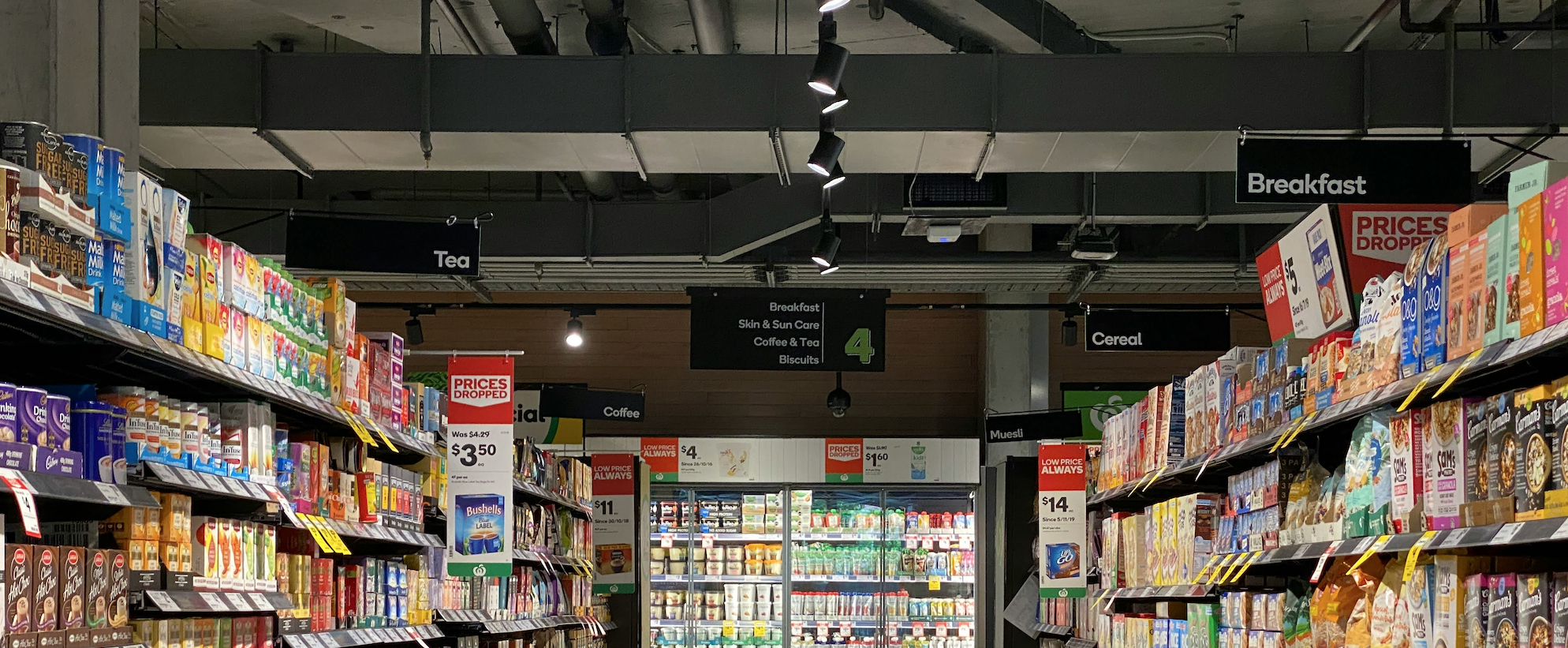
In a matter of weeks, cyber incidents have disrupted online grocery services at Food Lion and other Ahold Delhaize brands, while attacks on supermarket refrigeration systems in France and across Europe have spoiled food and raised safety concerns. In August, U.S. military commissaries also reported freezer failures that the Pentagon later treated as a suspected cyberattack. U.S. agencies are now warning that refrigeration controllers themselves are being targeted.
When supermarkets, fridges and food supply chains keep appearing in cyber headlines, it is natural to ask: why groceries, and why does it seem to be happening everywhere at once?
These incidents are not all confirmed to be connected, and they do not all involve the same systems. But together, they show how cyber risk in grocery retail can reach from websites and apps to the physical equipment that keeps food safe. The stakes are not just data or downtime: disruption can affect food availability, safety, cost and access.
Reported grocery and refrigeration cyber incidents: August–November 2026
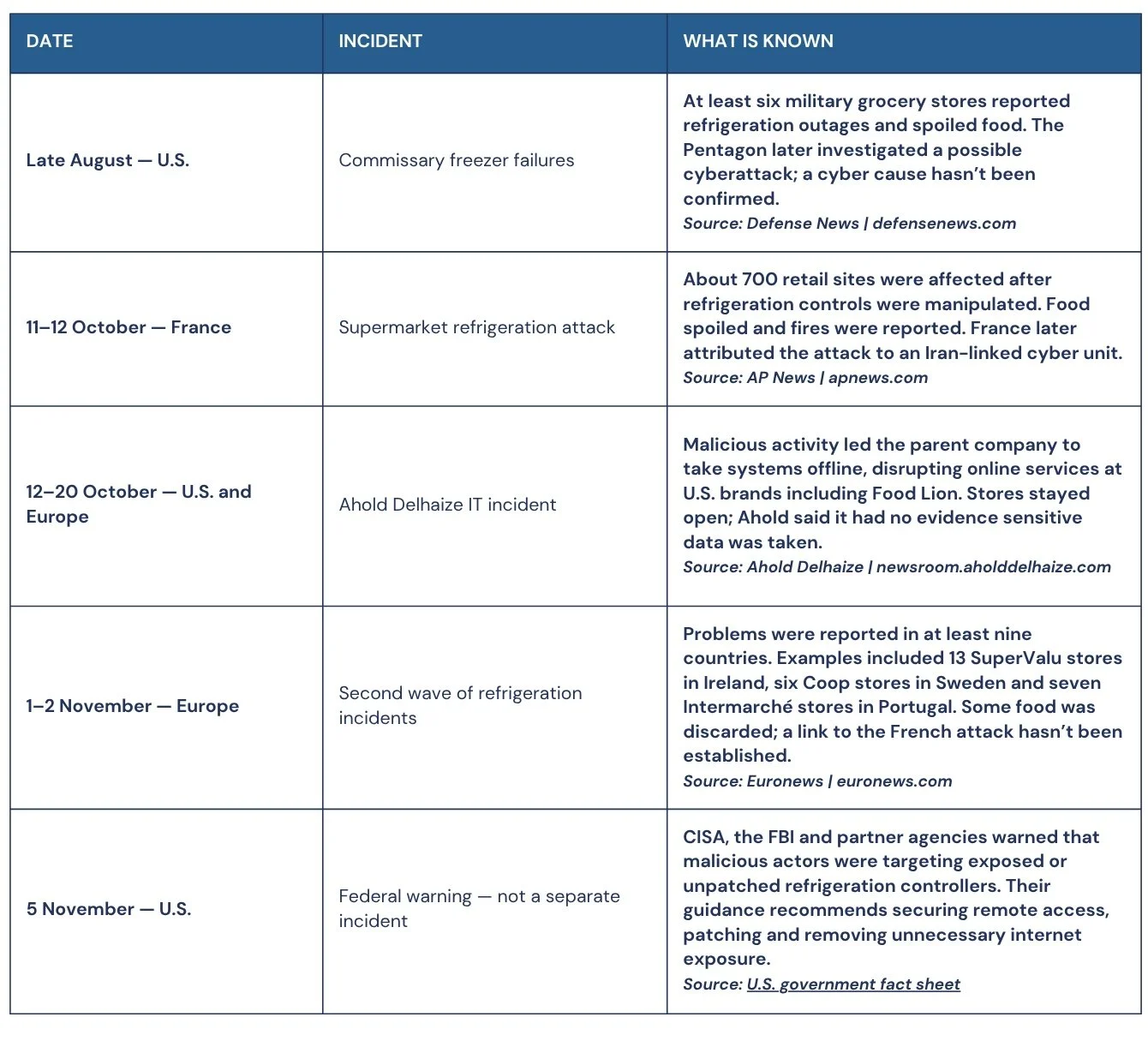
This is a summary of publicly reported incidents and advisories as of 16 November 2026. It is not a claim that every refrigeration outage was a cyberattack, or that the incidents were part of one campaign.
A supermarket is a network of physical systems
Modern grocery operations depend on far more than checkout terminals: websites, mobile apps, loyalty platforms, payment systems, inventory databases, warehouse tools, distribution networks and refrigeration controls all support the customer experience and the flow of food.
Some of those systems are operational technology: software and devices that monitor or control physical processes. Refrigeration controllers regulate temperatures and defrost cycles. They may be monitored or serviced remotely, including by external providers.
That connectivity is useful for operators, but it creates risk if controllers are exposed to the public internet, left unpatched, protected by weak credentials or connected too broadly to other networks. In its November warning, the U.S. government specifically cited unpatched or internet-accessible temperature and refrigeration controllers as targets. The warning does not establish the precise entry method used in each reported incident.
Why target a supermarket?
For financially motivated criminals, the attraction is leverage. A large retailer can lose revenue and face operational pressure when ordering, inventory, distribution or store systems stop working. Food is perishable, deliveries run on tight schedules, and customers need to shop today. Disruption can create urgency for management to restore systems and, in a ransomware scenario, pressure to negotiate.
That is a general explanation of why grocery operators may be attractive targets; it is not a confirmed explanation for the Ahold Delhaize incident or every refrigeration event.
The French incident also shows why it is important not to assume every attack is about ransom. France attributed that operation to an Iran-linked cyber unit, while the November European incidents remained unattributed and their connection to France was unconfirmed in public reporting. Different actors can target similar weaknesses for different reasons.
The technical impact can also be disproportionate to the action. A change to a temperature setting may not look like a sophisticated attack, but it can spoil inventory, create safety issues and interrupt service. In OT environments, a cyber incident can produce physical and economic consequences without stealing a customer database.
The impact does not fall evenly
For Food Lion and other Ahold Delhaize U.S. brands, stores stayed open, but websites and apps were taken offline. That affected online ordering and, according to grocery-industry reporting, access to some digital rewards and offers.
For some shoppers, an unavailable app is a temporary annoyance. For others, digital coupons, delivery, or pickup are part of how they manage time, mobility and the grocery budget. Alternatives through third-party delivery platforms may not be equivalent for every customer.
The refrigeration incidents create a different public cost: spoiled food and, in some cases, fires. The business pays for lost inventory and recovery, but customers and workers can still feel the effects through reduced availability, disrupted services and additional pressure on already stretched household budgets.
That is why describing a grocery cyber incident as “just an IT outage” misses part of the story. The systems being disrupted support access to an essential service.
What grocery operators can do
The U.S. agencies’ November fact sheet points to practical steps for organisations that use refrigeration and cold-chain systems:
Know what is connected. Maintain an inventory of refrigeration controllers, remote-management tools, cloud services and vendor connections.
Reduce exposure. Remove controllers from direct internet access where possible, and limit remote access to what is operationally necessary.
Harden access. Replace default credentials, use strong authentication, give vendors only the access they need and review accounts regularly.
Patch and replace. Keep supported systems updated, and plan to replace devices that no longer receive security updates.
Separate IT and OT networks. A compromise of a corporate account should not automatically provide a path to systems controlling store equipment.
Prepare for safe manual operations. Define who can respond to unexpected temperature changes, how stores protect food, and how customer services continue if apps, ordering or central management tools are unavailable.
These controls need to sit within broader risk management, supplier oversight, incident response and business continuity planning. Protecting customer data matters; so does keeping food safe and available.
Grocery cybersecurity is food resilience
The recent incidents do not show that every supermarket is under attack for the same reason. They do show that grocery operations rely on connected systems whose failure can quickly affect customers, workers, inventory and supply chains.
For operators, resilience means asking more than whether customer data is protected. It means knowing whether refrigeration controls are exposed, whether suppliers can reach critical systems, and what happens when an app or a controller has to be taken offline.
Because when a supermarket’s systems fail, people still need to eat.
Further reading
Defense News: Pentagon investigates suspected cyberattack behind U.S. commissary freezer failures
AP: France attributes supermarket refrigeration attack to Iran-linked unit
Reuters: Ahold Delhaize websites and apps remain offline during recovery
Euronews: countries affected by the November supermarket refrigeration incidents
Reuters: refrigeration incidents reported across European retailers
CISA, FBI and partners: industrial refrigeration and cold-chain cybersecurity fact sheet