
The Cybersecurity Reality of Thomson Reuters’ 'Fiduciary-Grade' AI
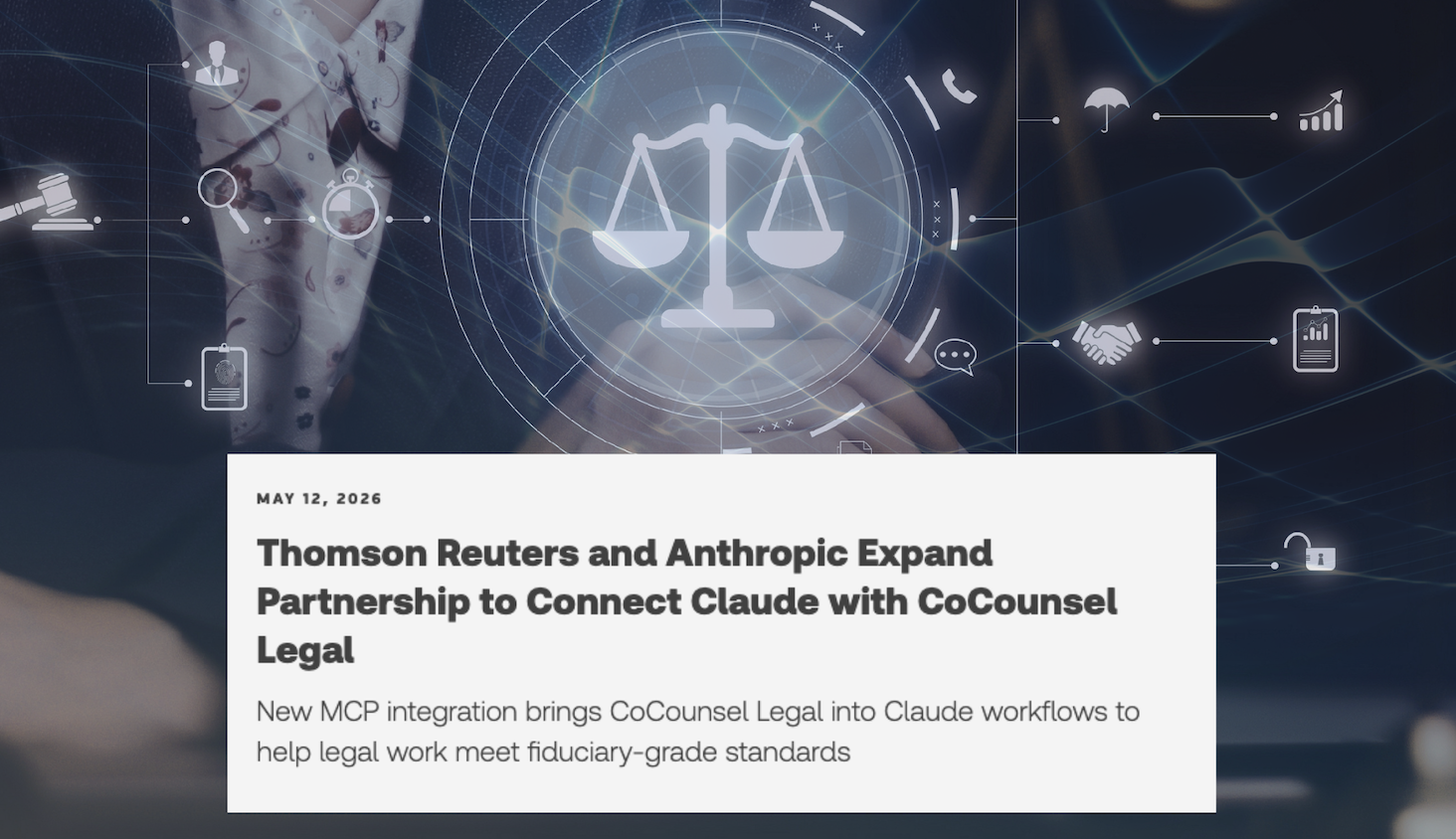
Last week, the legal and tech sectors just witnessed a massive shift in how professional artificial intelligence is deployed. On 12 May 2026, Thomson Reuters announced an expanded partnership with Anthropic that will connect Claude with CoCounsel Legal using Anthropic’s Model Context Protocol (MCP).
By embedding CoCounsel’s massive repository—1.9 billion Westlaw and Practical Law documents, alongside 1.4 billion KeyCite validity signals—directly into the Claude environment, the partnership aims to solve a persistent industry headache: bridging the gap between fast, general-purpose AI and the rigorous, verifiable demands of a legal or compliance practice. Thomson Reuters calls this standard “fiduciary-grade AI.”
But while legal tech enthusiasts celebrate the elimination of friction and platform-switching, a critical question emerges from a cybersecurity, data privacy, and compliance standpoint:
When general-purpose AI agents gain a direct, standardized pipeline into proprietary, high-stakes data environments, how do we secure the perimeter?
For organizations navigating this transition, the intersection of productivity and risk has never been more complex.
What is Model Context Protocol (MCP)?
To understand why this integration is such a major architectural shift, it helps to look at the technology acting as the glue: Anthropic's Model Context Protocol (MCP).
Historically, using an AI model meant operating within a closed loop. If you wanted an LLM to analyze a case, review a contract, or access proprietary data, you had to manually upload files, paste text, or build highly complex, custom API integrations for every single software tool. The AI was essentially a brain isolated from your actual enterprise workspace.
Introduced as an open-source standard, MCP completely changes this dynamic. Think of it as a universal USB port for AI: instead of building fragmented, custom pipelines for every separate application, MCP provides a secure, standardized protocol that allows Large Language Models (LLMs) to safely plug directly into external data sources and enterprise tools.
Under this protocol, the architecture is split into two primary components:
MCP Hosts: Advanced AI applications (like Claude) that initiate connections and act as the primary user interface.
MCP Servers: Venture databases, APIs, or data repositories (like CoCounsel Legal) that securely expose specific tools and text documents to the host.
By establishing this open pipeline, an AI agent no longer just reads static text; it can dynamically query verified databases, cross-reference massive compliance ledgers, and pull precise real-time data exactly when a prompt demands it.
The Double-Edged Sword of MCP
From a productivity lens, transforming an LLM into an active, contextual operator via MCP and the Claude Agent SDK is a massive leap forward. Instead of treating an AI as a chat box where humans copy-paste text, it turns the AI model into a dynamic operator that can plan, select its own specialized tools, retrieve authoritative content, and adapt its processes mid-workflow.
From a cybersecurity perspective, however, it introduces a dynamic execution environment where an AI model autonomously chooses which data repositories to query and which workflows to trigger based on plain-language prompts. This introduces specific compliance and security dimensions that tech leaders must audit:
1. Data Isolation and Sovereignty Boundaries
Thomson Reuters has explicitly stated that customer data is not used to train third-party models and remains confined to the user’s environment. This addresses primary concerns about copyright and data leakage. However, when utilizing automated agent protocols, organizations must still map precisely where inference occurs and where data rests.
For highly regulated environments (such as Australian firms navigating APRA regulations or European firms bound by GDPR), the path data takes when moving between a general-purpose assistant interface and a citation-grounded research database must be subject to strict cryptographic controls and regional data residency constraints.
2. Agentic Risk and the "Black Box" Challenge
When an AI agent is empowered to select its own tools and formulate its own multi-step inquiries, verifying the integrity of the data pipeline becomes essential. As these protocols proliferate, cybersecurity teams must implement rigorous logging mechanisms (such as ABA 512 audit logging frameworks) to ensure that every step the agent takes—every document retrieved, every tool executed, and every data repository touched—is transparent, immutable, and fully auditable.
3. Over-Reliance, Verification, and Malpractice Liability
The term "fiduciary-grade AI" is a powerful marketing positioning statement, but legally, the liability always remains with the human professional. While a patent-pending citation ledger that can be traced with a single click reduces the risk of AI "hallucinations," it introduces a psychological risk: automation bias.
Compliance and security teams must implement internal policies ensuring that AI-generated work product goes through rigorous human-in-the-loop validation before execution. An AI tool can be an extraordinary co-pilot, but it cannot assume fiduciary duty under the law.
Securing Your Transition to Professional-Grade AI with Seratos
The line between consumer-grade AI convenience and enterprise-grade security is the defining battlefield of modern digital operations. The Thomson Reuters and Anthropic integration proves that the market is moving rapidly toward connected, agentic ecosystems. Standing still or banning AI is no longer a viable risk-mitigation strategy; instead, organizations must build secure, resilient frameworks to adopt these tools safely.
At Seratos, we act as your dedicated compliance and cybersecurity partner, ensuring your organization safely capitalizes on these agentic breakthroughs without exposing your proprietary data to systemic vulnerabilities.
We help you bridge the gap between innovation and absolute governance through targeted, professional services:
AI Security Assessments & Readiness: We audit how generative AI systems, agentic protocols, and third-party integrations interact with your local environments, ensuring data isolation boundaries remain completely secure.
Governance & ISO 42001 Framework Alignment: We help map your data pipelines to ensure strict alignment with evolving local regulations and international benchmarks. Through our specialized readiness assessments, we prepare your business to align with ISO 42001 (the international standard for AI Management Systems), giving your clients total confidence in your AI governance.
Audit Logging & Infrastructure Monitoring: We implement advanced, forensic-level logging structures to track automated tool execution, ensuring full accountability and visibility for every action taken by an AI agent within your digital workspace.
Policy and Workflow Design: We work alongside your leadership teams to draft sensible, practical AI usage policies that define clear boundaries for human-in-the-loop verification, ensuring your enterprise maintains the highest standard of professional care.
The future of professional work belongs to those who can move from exploration to execution at the speed of an AI agent—shielded by the uncompromising security of enterprise-grade governance.
Ready to safely deploy the next generation of professional AI? Discover how we secure your data and streamline your compliance.