
The Risk of Successful AI: When Productivity Becomes Overproduction
The debate about artificial intelligence and risk tends to gravitate toward the spectacular. We worry about machines escaping human control, autonomous systems pursuing objectives we did not intend, mass displacement of human work or, at the extreme, artificial intelligence becoming an existential threat.
These are legitimate questions. But they are difficult questions for an executive trying to decide what to do on Monday morning.
There is another AI risk emerging much closer to the operating surface of organizations. It does not require artificial general intelligence, malicious machines or even particularly unreliable AI. In fact, it can arise from AI doing exactly what organizations purchased it to do.
The risk is that AI increases our capacity to produce consequential work much faster than our organizations can marshal the scarce resources required to turn that work into meaningful outcomes.
Here is why human oversight collapses under sheer volume, how vanity output metrics mask declining performance, and what flow controls are required to ensure AI creates value rather than backlogs.
1. The Economics of Cognitive Overproduction
The industrial economy proved that producing more does not automatically yield equal value. In the late 1920s, factory output surged past market absorption capacity. While overproduction was only one factor in the Great Depression, the takeaway remains clear: the capacity to produce differs fundamentally from the capacity to capture sustainable value.
AI creates this dynamic in knowledge work.
Historically, friction limited output. Research, writing, code deployment, and contract review demanded billable human hours. Generating ten options cost ten times more than generating one.
Generative and agentic AI erased that cost floor. Teams can now spin up alternative drafts, test scenarios, and vulnerability scans instantly.
Yet only the generation stage scaled. Human attention, technical judgment, organizational authority, and implementation speed remain fixed.
A September 2026 paper by researchers at Emory, Cornell, and Carnegie Mellon terms this "cognitive work-in-process": AI makes viable analyses cheap, but every asset requires human review before action or disposal. Like inventory piling up on a factory floor, it consumes organizational resources just sitting there.
2. Downstream Bottlenecks: The Shift from Generation to Integration
Software development highlights this shift clearly:
AI tools dramatically increase code generation.
That code must still be understood, reviewed, tested, merged, secured, and maintained.
In Black Duck’s 2026 survey of 831 engineering professionals, 92% reported increased velocity from AI assistants, yet 90% ran into workflow bottlenecks—chiefly manual review, security testing, and rework.
When creation becomes frictionless, review becomes the bottleneck.
3. The Flaw in "Human-in-the-Loop" Governance
Consider a legal practice using AI to draft arguments and analyze contracts. An associate can generate multi-angle analyses in minutes.
The output still needs verification. Legal logic must align with case facts, drafts require partner scrutiny, and firm accountability remains unchanged. AI multiplies drafting capacity, but partner attention remains finite.
This exposes an operational contradiction: enterprises adopt AI because human cognition is scarce, then rely on that same scarce capacity to govern the avalanche of AI output.
"Human-in-the-loop" sounds responsible until output triples. The question is not whether a human touches the deliverable, but whether qualified teams have the bandwidth to review it rigorously at scale.
4. How Cognitive Overproduction Drains Core Capacity
Unnecessary AI deliverables are cheap to create, but expensive to carry. Someone must evaluate, discuss, accept, or reject them.
Every low-value asset siphons attention from high-leverage work:
A partner checking peripheral case analyses has less time for client strategy.
A staff engineer triaging AI code has less bandwidth for core architecture.
A security analyst sorting hundreds of auto-generated alerts has less time to patch critical infrastructure.
When teams spend their days managing what machines spit out, aggregate performance drops. That is true cognitive overproduction: the organization burns scarce resources simply babysitting its own output.
5. The Hidden Drift: Why Capacity Failure Stays Invisible
Overcapacity rarely announces itself as an immediate backlog. Teams adapt at first:
Reviewers skim rather than evaluate.
Plausible arguments face less scrutiny.
Spot-checks replace full audits.
Escalation bars rise; low-tier alerts get ignored.
An auxiliary AI is deployed to review the initial AI.
Compliance checklists show 100% review rates, but attention per asset has collapsed.
5.1. The Cybersecurity Paradox: When Detection Outpaces Remediation
In July 2026, the Bank of England reported that Palo Alto Networks surfaced 75 security issues across 26 CVEs in a single monthly update (up from fewer than five), driven by frontier AI. Mozilla fixed 423 Firefox bugs in one month—20 times its historical baseline.
Accelerating detection is an obvious win. The secondary operational risk is acute: teams must now evaluate, patch, and regression-test fixes at impossible tempos, increasing configuration errors and outages.
Solving the intake problem simply breaks remediation downstream.
6. The AI Productivity Trap: Vanity Output vs. Business Outcomes
Tracking AI success via production volume creates a false signal:
Lines of code written
Reports generated
Alerts surfaced
Hours claimed saved
A security operations team is not 5x more secure because it logged 5x more tickets. A team does not deliver 5x client value by writing 5x more memos.
The California Management Review notes this as the "cognitive rebound effect": as cognitive generation costs plummet, organizations run more tasks, generating downstream drag that wipes out initial efficiency gains.
Capacity is not utilization: just because an agent can draft 50 market analyses does not mean leadership needs 50.
7. How to Measure and Audit the AI Capacity Gap
Replace vague governance scores with operational workflow diagnostics:
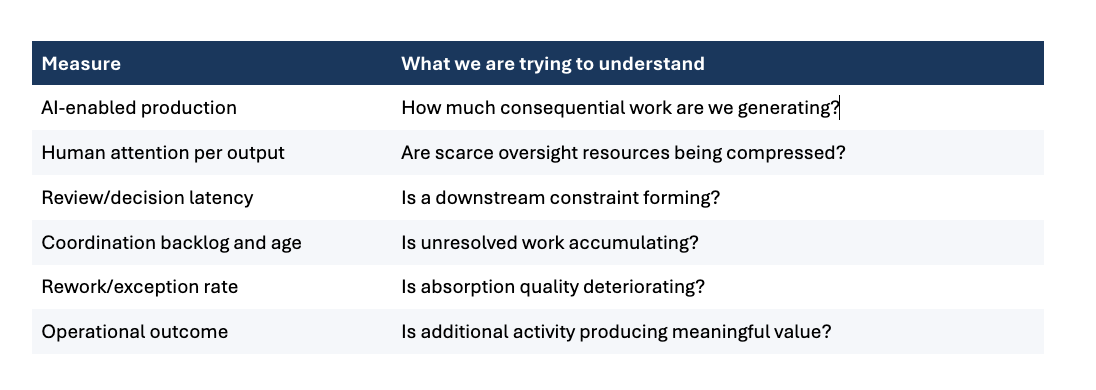
If output climbs while attention per asset falls, coordination strain increases, and rework spikes, AI capacity is consuming enterprise capacity.
A simple ratio governs performance: useful outcomes divided by consequential work generated. AI makes the denominator essentially free. Leaders must ruthlessly guard the numerator.
8. Solving Cognitive Bloat: Implementing AI Flow Control
The answer is not throttling model speeds, but rather applying systems engineering to cognitive work.
Data networks manage sender-receiver packet flow. Lean factories balance upstream supply with downstream station capacity. AI implementations must adopt the same controls:
Invert the workflow: Define the strategic objective first, scope the minimum work needed, apply AI surgically, confirm team absorption capacity, and evaluate outcomes. Never generate maximum volume and then scramble for places to file it.
Cap run rates: Do not convert raw model capacity into organizational noise.
Prioritize selectivity over volume: When generative capability is unlimited, competitive advantage belongs to the firm with the discipline to decide what is worth producing, what can actually be executed, and when to stop.
9. The Path Forward: Managing the AI Flow
The ultimate competitive advantage in the AI era is not generating the highest volume of code, analysis, or documentation. It is knowing what to produce, ensuring human teams have the qualified bandwidth to act on it, and establishing structured guardrails before backlogs overwhelm core operations.
Turn AI governance into an operational asset.
Aligning output with accountability is what the ISO 42001 AI management standard was designed to solve. Whether you are scaling internal agentic workflows or vetting vendor models, Seratos provides the frameworks, gap assessments, and advisory support needed to achieve certifiable, sustainable AI governance.
Connect with us to assess your ISO 42001 maturity and build an AI management system that protects your team's focus.